
The open: a 13% gap on historic news
On Thursday morning, Nvidia's board announced that Jensen Huang had resigned as president, CEO and director, effective immediately. CFO Colette Kress is now interim CEO while the board searches for a permanent successor.
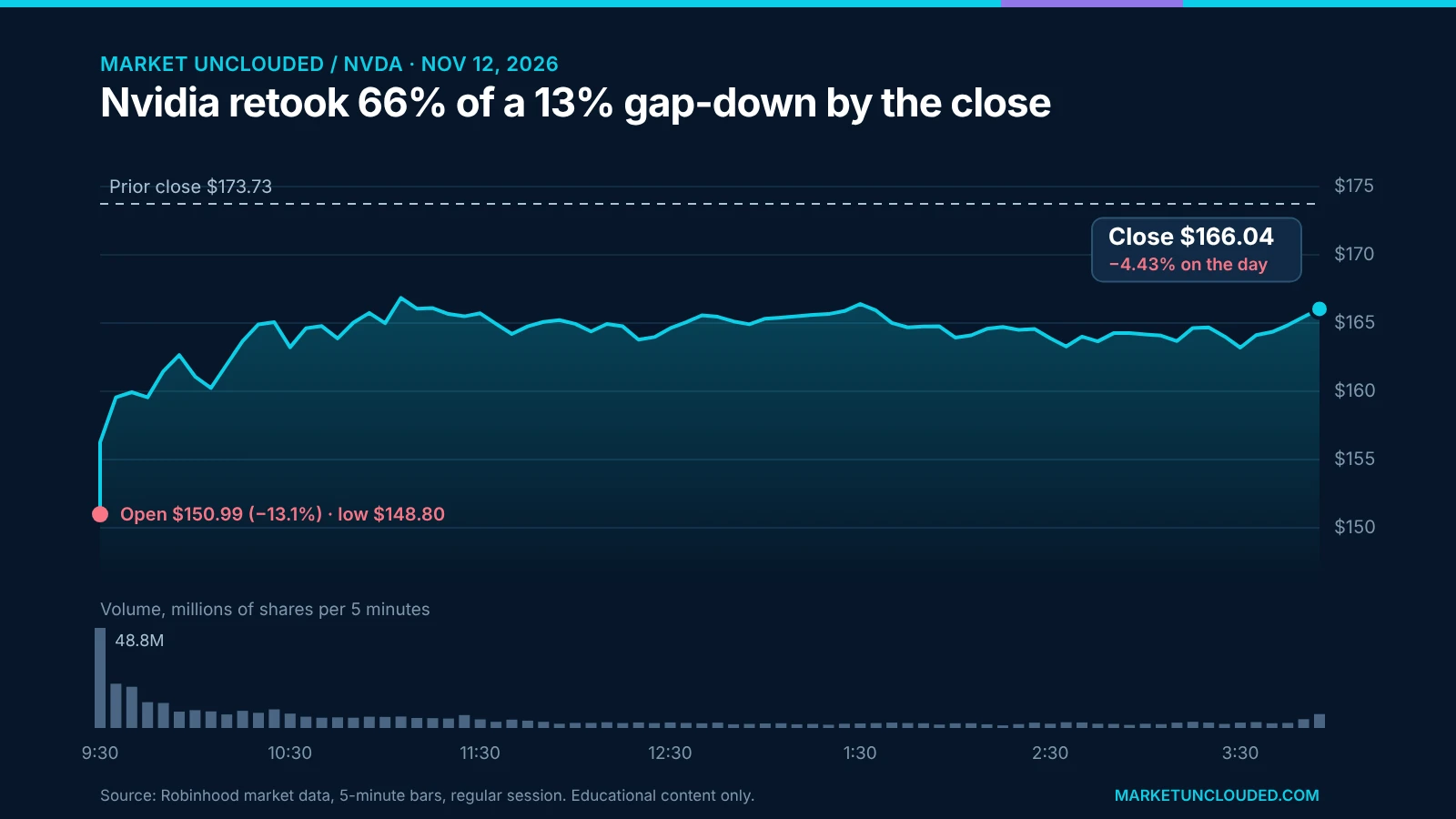
The stock closed Wednesday at $173.73. Its first trade Thursday was $150.99, down 13.1%. It touched $148.80 in the first five minutes.
Then it climbed. NVDA closed at $166.04, down 4.4% on the day. Buyers took back about 66% of the opening gap.
That looks like strength. Sometimes it is. Sometimes it is the start of a trap. The difference is in the details, not the headline number.
Why the first print is the least reliable signal
An opening price after big news is not a careful verdict. It is the result of every order that piled up overnight, all hitting at once.
That pile is lopsided. It holds stop-losses that trigger automatically, funds cutting risk by rule, and people selling on the headline alone. Buyers who want to wait and see are mostly absent at 9:30.
So the first print often overshoots. The useful information arrives over the next hour, as patient money decides what the news is actually worth. We covered this idea in Confirmation Matters More Than the First Move. Today was a live example.
Four tests for whether a reversal is real
No single number proves a reversal. These four checks, taken together, tell you how much weight to put on one.
1. How much of the gap was taken back?
A bounce of 10–20% of the gap is noise. Reclaiming half or more means real buyers absorbed the forced selling. Nvidia retook about 66% by the close. Passes.
2. What did volume do?
About 90.5 million shares traded in the first 15 minutes. By the afternoon, trading had slowed to roughly 2 to 3 million shares per five minutes, with a pickup in the final ten minutes. Huge volume at the low followed by calm says the panic was absorbed. But the climb itself came on light volume, which shows less conviction. Mixed.
3. Is the stock holding a level?
After about 10:15 AM, Nvidia did not trade below $161.82. That makes the $160–162 zone the level to watch. It closed about $7.70 below Wednesday's close, though, so the gap is not filled. Holding, but unfinished.
4. Does the sector agree?
If the news had broken the whole AI chip trade, peers would have sold off too. Instead the chip ETF SMH closed down only 1.0%, while AMD rose 5.9% and Broadcom 5.6%. The market treated this as an Nvidia leadership problem, not an AI demand problem. Passes.
What the reversal does not tell you
A strong recovery describes today's trading. It does not settle the business questions behind it.
- Who runs Nvidia long term. Kress is interim. The board says it will consider internal and external candidates, and no timeline is set.
- What earnings will show. Nvidia reports fiscal third-quarter results on November 17. One quarter of numbers will matter more than one day of price action.
- Whether the story is finished. Shares had already fallen for days on the board investigation before today. New details could restart the selling.
Price tells you how traders are positioned. It cannot tell you how a leadership change plays out over the next year.
A checklist for the next big gap-down
Save this for the next time a stock you follow opens sharply lower on news.
- Wait out the first 15–30 minutes. Let the overnight orders clear before judging anything.
- Measure the retracement. Divide the bounce by the size of the gap. Under a third is weak; over half is meaningful.
- Compare volume at the low with volume on the bounce. Heavy selling that dries up is a good sign. A bounce that fades as volume fades is a warning.
- Find the level that holds. Note the price the stock refuses to break after the open. That is your line in the sand.
- Check the peers. If competitors and the sector ETF are steady, the problem is company-specific.
- Separate the chart from the story. Ask what news could still change the picture, and when it might arrive.
The takeaway
Today's open showed fear. The rest of the session showed something more useful: how much of that fear patient buyers were willing to absorb. Learning to read that second phase is a skill you can practice on every news-driven gap.
Options data for these tickers: NVDA · SMH · QQQ. Each page shows the expected move, max pain, gamma levels and options flow, updated through the trading day.
NVIDIA Form 8-K — NVIDIA Announces CEO Transition (Nov 12, 2026)
Reuters via Yahoo Finance — Global AI stocks pare losses (Nov 12, 2026)
Price and volume data: Robinhood market data, 5-minute bars, November 12, 2026 regular session.
Educational content only. This article is general market commentary, not personalized investment advice or a recommendation to buy or sell any security. Trading stocks and options carries substantial risk, including loss of capital.